
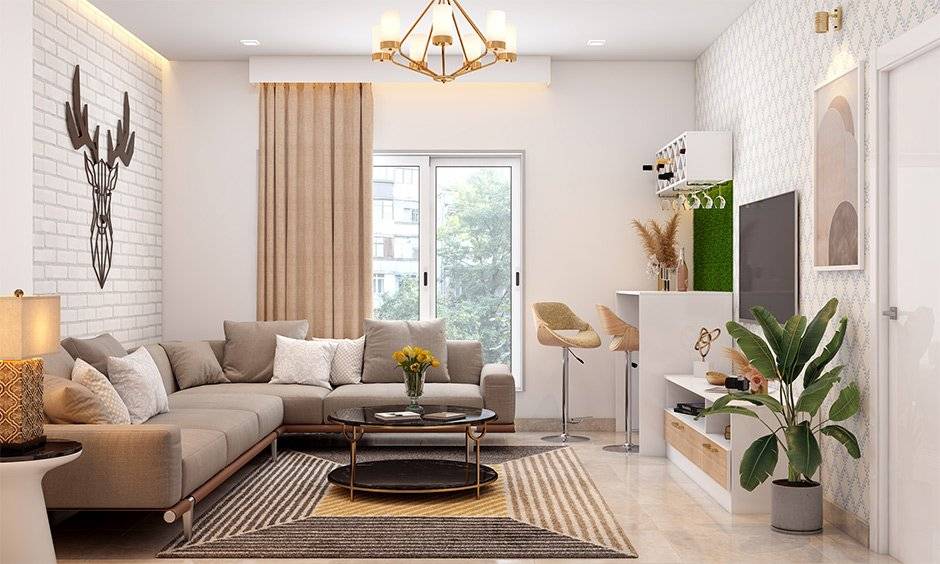
The biggest mistake in a long narrow living room layout is pushing all furniture against the walls, which creates a “bowling alley” effect. Instead, pull the sofa away from the wall and use it as a divider to create two distinct zones—perhaps a TV area on one side and a reading nook or small workspace on the other. This breaks up the length and makes the room feel wider.
A narrow room is not a problem to work around – it is a layout puzzle with reliable solutions. Once you understand the three core strategies below, you will have a clear plan for transforming even the most awkward proportions into a functional, comfortable space.
Strategy 1: Zone the Room Across Its Width
Instead of treating a long narrow room as one single space, divide it into two or three distinct zones arranged side-by-side across the short dimension. This is the most effective way to break up the tunnel effect.
A common approach for a 10×20 ft room: create a seating zone at one end and a reading or dining zone at the other. Use a sofa facing across the width (not along the length) as the dividing element. The sofa’s back becomes a natural visual partition between the two areas.
Rugs are your best tool here – a rug placed under each zone reinforces the separation without needing walls or dividers. Two 5×7 rugs in a long room read as two distinct spaces far more effectively than one long runner.
Strategy 2: Use Furniture That Interrupts the Length
Anything that draws the eye across the room (horizontally) rather than down it (lengthwise) helps counter the tunnel feeling.
|
Do This |
Avoid This |
|
Orient the sofa across the room’s width |
Placing the sofa along the long wall |
|
Use a wide, low media console or sideboard |
Tall narrow bookcases on the long walls |
|
Hang wide horizontal artwork or a gallery wall |
Vertical art that emphasises the height of long walls |
|
Use a square or round coffee table |
A long rectangular coffee table parallel to the sofa |
|
Place an armchair or accent chair angled across the corner |
Lining all seating along one wall |
|
Use a patterned rug with horizontal lines or a wide motif |
A runner rug laid lengthwise down the middle |
Strategy 3: Make the Short Walls the Focus
The two short walls – the ones at each end of the room – are your greatest design assets in a narrow space. Make them visually interesting and the eye will naturally travel end-to-end rather than dwelling on the walls’ closeness.
- Hang a large statement mirror or oversized artwork on one short wall. This creates depth and draws attention immediately when you walk in.
- Place your television or media setup on the short wall, with seating arranged facing across the room toward it. This is both practical and layout-smart.
- A floor-to-ceiling bookcase or built-in shelving on a short wall adds enormous visual interest and makes the room feel intentional rather than constrained.
Rug Placement in a Long Narrow Room
Rug placement is where most narrow room layouts go wrong. A rug that runs lengthwise acts like an arrow pointing down the tunnel. Instead:
- Use a rug that is wider than it is long, or at least square. This counteracts the room’s proportions.
- In a zoned layout, use two separate rugs – one per zone – rather than one large rug spanning the room.
- Leave at least 12 inches of bare floor visible on all sides of the rug. A rug that goes wall-to-wall makes even a narrow space feel slightly cramped.
Lighting Tricks for Narrow Rooms
Lighting affects how wide a room feels far more than most people realise.
- Wall sconces on the long walls throw light outward and make the walls feel farther apart than they are. Install them at eye level (about 60-65 inches from the floor).
- Floor lamps placed in the corners of each zone add warmth and visually expand corners.
- Avoid a single overhead pendant in the centre of the room – it highlights the length and casts the corners in shadow.
- A mirror placed opposite a window doubles the natural light and makes the room feel significantly wider during the day.
A Practical Layout Example: 10 x 20 ft Living Room
Zone 1 (Entry end – roughly 8 ft deep): A two-seater sofa facing the short wall, a square coffee table, one armchair angled in the corner. A 5×7 rug anchors the arrangement. A wide sideboard or console on the short entry wall.
Zone 2 (Far end – roughly 8 ft deep): A reading chair and floor lamp beside a small side table, or a narrow dining table for two with two chairs. A second 5×7 rug defines this zone separately from Zone 1.
Transition space (middle 4 ft): Left relatively open, with a low bench or narrow console to create a natural visual pause between zones without blocking movement.
The One Rule That Ties It All Together
Every decision in a long narrow room should ask the same question: does this make the eye travel across the room or down it? Furniture arranged across the width, art hung horizontally, rugs placed wide rather than long – all of these push perception in the right direction.
Done well, a narrow living room can feel intentional, cosy, and surprisingly spacious. The shape is a constraint that, with the right approach, becomes a design feature rather than a flaw.